Biomaterials · Research briefing
Spirulina in edible packaging: what the new research supports
A review published on 17 November 2026 examines spirulina as an ingredient in edible packaging materials. For food developers and ingredient businesses, this opens a research question: what could spirulina contribute to a film or coating, and what evidence would be needed for a specific application?
Why this application is in focus
The new Frontiers in Sustainable Food Systems review considers spirulina-derived components alongside plant resins and gums in packaging research. It discusses possible film-forming and active functions, while identifying unresolved issues around moisture resistance, mechanical performance, sensory acceptance and production scale. It is a synthesis of research, not a commercial product launch or a new factory trial.
The review distinguishes a film, formed separately before use, from a coating applied directly to food. That distinction matters when deciding what to develop. Our earlier paperboard packaging article examined containers for supplements. Here, the subject is spirulina as part of a packaging formulation.
What an experimental film actually contains
An earlier primary study gives a concrete example. In Scientific Reports, published on 14 May 2026, Omidi and Haghighi investigated a composite containing psyllium, sorbitol, wheat-straw protein isolate, spirulina and glycerol. The researchers varied selected formulation components and measured properties including strength, flexibility, water-vapour permeability and laboratory bioactivity.
Spirulina was one part of that multicomponent system. Its published results describe the prepared films under the study's methods. They do not establish that a bag of spirulina powder, used in a different recipe, will produce the same behaviour. This May study supplies background evidence; the November review is the current reason for revisiting the application.
Choose the role before choosing the recipe
A useful project proposal starts with the job the material should perform. Is the aim to create a separable sheet, apply a coating to one food, or explore a particular measured effect? Write that objective in a sentence that the laboratory and the commercial team can both understand.
For example, “compare two experimental coatings on the same product under the same storage conditions” is a workable starting question. “Create sustainable packaging with spirulina” leaves the food, format, measurement and intended user undefined. The narrower question also makes it easier to decide what evidence would justify continuing the project.
Keep the role of each formulation component visible in the experiment plan. If several components change together, ask the researchers how they will distinguish their contributions. A well-documented unsuccessful comparison can still help the team rule out an approach without making a broader claim about the ingredient.
| Project question | Comparison to request | What to document |
|---|---|---|
| What does the spirulina addition contribute? | A defined formulation comparison with an appropriate control | All ingredient and processing changes between samples |
| Does the proposed function matter on the chosen food? | A study designed around that food and its intended conditions | The measured outcome, test duration and limitations |
| Can the method be reproduced? | Repeat preparations using documented inputs and settings | Variation between runs and reasons for excluding samples |
Keep the result attached to its test
When reviewing a paper or a partner's presentation, preserve the test name next to the result. A measurement on a film specimen answers a different question from an observation on packaged food. Ask which result is actually available before writing a claim for a customer or an internal investment proposal.
Use a short evidence record for each proposed claim: the exact formulation, comparison, test conditions, result and remaining question. If the research only measured a material property, describe that property. If a future food trial is planned, list it as planned work. This gives development partners a clear view of what has and has not been demonstrated.
Apply the same care to environmental language. Ask what was measured, over what period and in which conditions before using a disposal or degradation claim. Keep a proposed environmental advantage as a project objective until the evidence for the finished design is available.
Separate the research sample from the launch decision
At the start of a collaboration, agree whether the deliverable is a literature assessment, a laboratory sample or a tested prototype. Give each stage its own decision. A promising sample might justify another experiment without justifying a production commitment or a customer-facing promise.
Ask the development partner to identify what remains to be assessed for the intended food, use and market. That discussion should cover the complete formulation, the intended handling and any supporting safety or regulatory work. This article does not establish approval for an edible film or recommend a recipe for consumption.
For an ingredient request, specify whether the research needs whole biomass or a particular fraction. Include the study's material requirements, proposed quantity and document questions. The supplier can then confirm whether its current offering matches the request; suitability should not be inferred from a general product name.
Questions from ingredient and food businesses
Does the new review prove commercial demand?
No. It provides a timely research perspective. It does not establish purchase volumes, a market price or commercial availability for a Solenyx packaging product.
Can we use a study's performance claim for our own film?
Keep the published claim attributed to the tested system. Your team needs evidence relevant to its own formulation and intended use before deciding what it can communicate about the resulting material.
What is a sensible next step?
Prepare one specific development question and discuss it with a packaging research partner. If the work needs spirulina material, send a separate ingredient enquiry with the required identity and documentation.
Discuss a spirulina research requirement
Share your intended application and material questions through the bulk enquiry page, or contact Solenyx Farms to confirm current supply options. No finished edible film or validated packaging formulation is offered by this article.
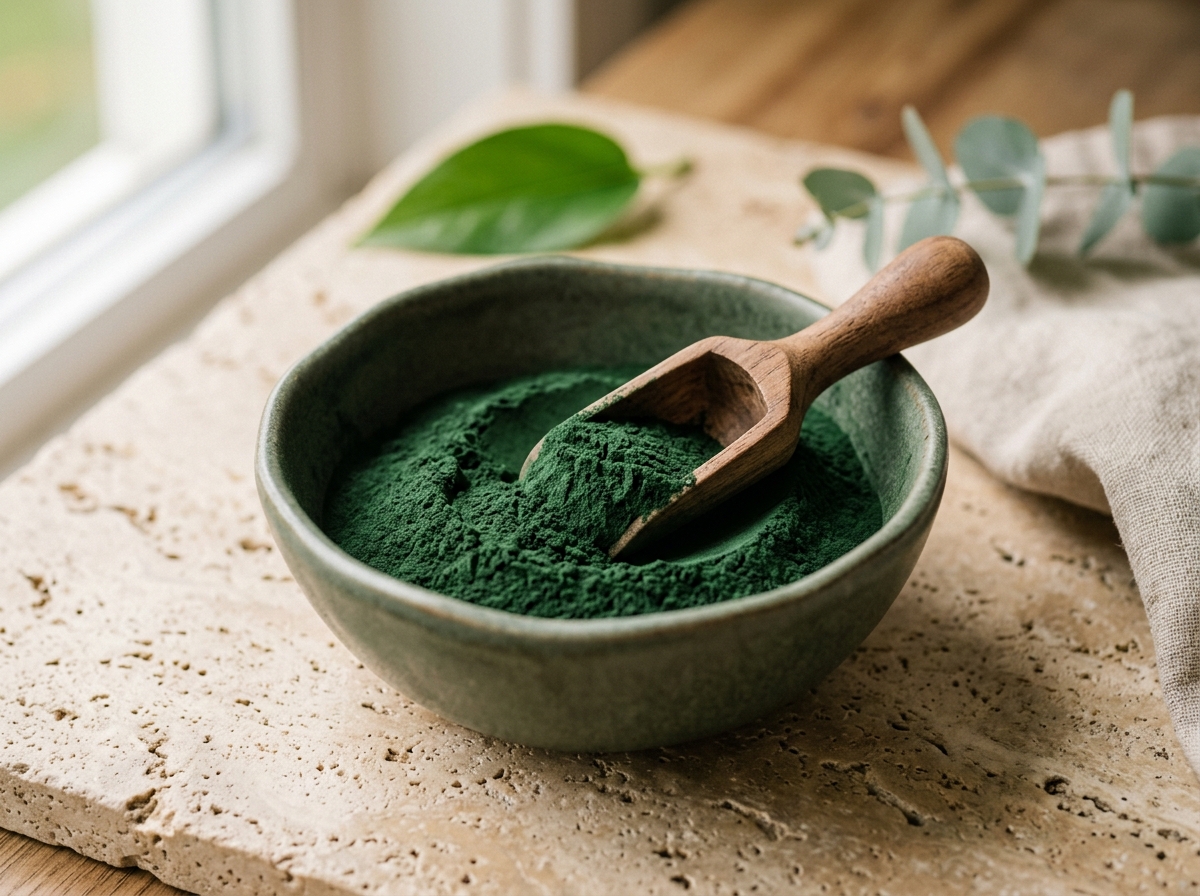
Sources reviewed on 23 November 2026: the November 17 Frontiers review and the May 14 Scientific Reports experiment. The research-planning questions are editorial guidance. The featured image illustrates powder, not a tested film or a photograph of a research result.